Elevators for House Rentals Michigan: Accessibility, Insurance & ROI
January 9, 2026
Safe & Simple: Installing a Grab Bar in a Fiberglass Shower
January 23, 2026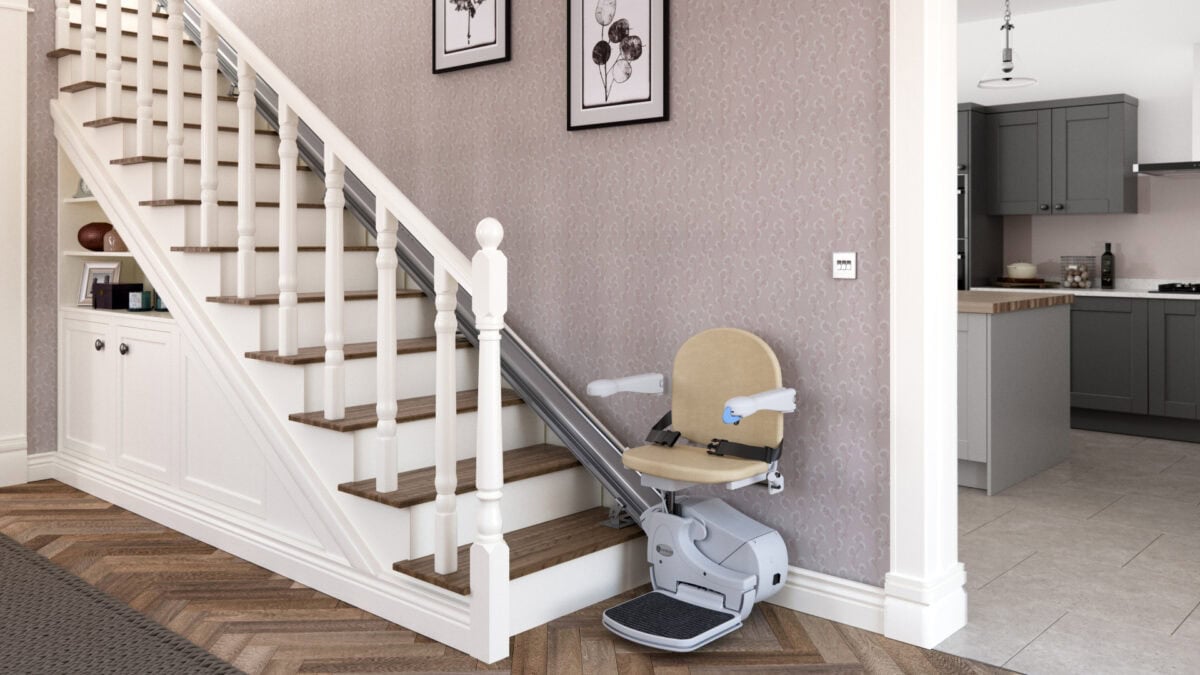
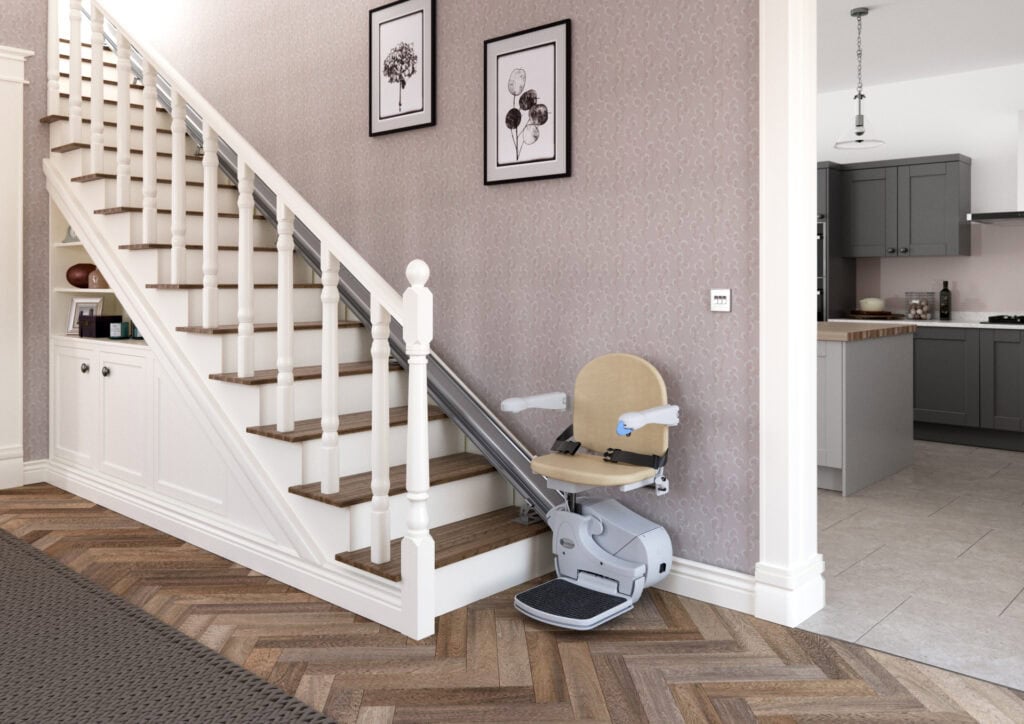
If you’ve been wondering, ” Can stairlifts be fitted to any stairs, you’re not alone. Homes come with straight runs, sweeping curves, pie-shaped steps, split landings, doorways near the top tread—and sometimes all of the above. The good news: in most homes, there’s a path to a safe, code-conscious install. The nuance is in the details—stair width, headroom, turns, landings, obstructions, and the best rail type for your layout and budget.
Below, we break down how installers evaluate fit for straight, curved, and narrow stairs, what to expect for clearances and power, and the tradeoffs that influence comfort, reliability, and long-term value. When you’re ready to assess your exact staircase, start here: Can stairlifts be fitted to any stairs.
Quick answer: usually yes—with the right rail and setup
- Straight stairs: Typically the fastest and most affordable installations, using modular straight rail sections.
- Curved/turning stairs: Fully custom rails follow curves, landings, and spirals; precise measurements are essential.
- Narrow stairs: Many chairs fold compactly; with adequate width and headroom, a solution is often possible.
- Obstructions: Doors, low soffits, radiators, and handrails can be worked around with planning and options.
- Power: Standard household power typically suffices; modern lifts use battery backup for smooth rides.
So, can stairlifts be fitted to any stairs? In practice, nearly any staircase can be served, provided the chosen system and configuration match the structure and user needs.
How pros evaluate your staircase in minutes
1) Clear width & fold-up footprint
Installers look at the narrowest point of the staircase and compare it to the chair’s folded profile. A common goal is to maintain a clear passage for other household members when the chair is parked or folded. If space is tight, options include slim chairs, folding arms/seat/footrest, and parking the carriage on a landing to open the travel path.
2) Headroom & ceiling features
Low ceilings, sloped roofs, pendant lights, or stairwell soffits can limit seating position. Solutions include adjusted rail pitch, alternate mounting positions, and top/bottom overrun sections to start/stop on landings with more headroom.
3) Landings, turns, and doorways
Split landings, quarter-turns, and doors near the top tread are common. Curved rails can bend around newels, climb wedges (pie steps), and park beyond a doorway so transfers happen in a safe, open spot.
4) Rail mounting & structure
Most residential installations mount the rail to treads rather than to the wall, avoiding major drywall work. Your installer verifies tread strength and checks for loose or squeaking steps, which should be tightened before mounting.
5) Power access & charging
Modern units typically charge on the rail at designated points. A nearby standard outlet (often at a landing) is enough. Battery systems ride smoothly even during brief outages.
Straight stairs: fast, predictable, budget-smart
If you’re asking whether stairlifts can be fitted to any stairs in a typical straight run, the answer is almost always yes. Straight lifts use standardized rails cut to length, so installation time and costs are lower than those of custom curved systems. You’ll choose:
- Seat style & capacity: Standard or heavy-duty options.
- Controls: Armrest toggles, call/send remotes, and safety sensors along the carriage.
- Parking: Top or bottom landing, or a short overrun that parks off the main stair.
Pros: Quick turnaround, serviceable parts, simple maintenance.
Consider: If you may add a turn later (remodel, new landing), note that a straight rail won’t adapt to future curves.
Curved stairs: custom-fit rails for bends and landings
Curved stairs—quarter-turns, half-turns, spirals, or multilevel runs—call for a custom rail engineered to your staircase’s exact geometry. This is where precision measuring matters, often using photo-mapping or laser tools so the rail arrives ready to hug every bend.
Advantages:
- One-seat, whole-journey convenience: No transfers between flights.
- Clean parking: Rails can tuck the chair around a corner or off a landing, keeping the hallway clear.
- Safety in complex layouts: Smooth travel around newels and pie steps reduces awkward maneuvers.
Considerations:
- Lead time and cost: Custom manufacturing raises both.
- Future changes: If you later alter the staircase, the rail may require rework.
If your priority is one-button, door-to-door access with minimal transfers, a tailored curved rail is often worth it.
Narrow stairs: how narrow is too narrow?
“Narrow” is relative to your chair’s folded dimensions and how many people need to pass while the chair is parked. Many modern lifts are designed with slim profiles and folding arms/seat/footrest to reclaim passage space. For very tight runs:
- Set-and-park strategy: Park the chair at a landing or in an alcove to keep the staircase clear.
- Railside choice: Mounting on the side with more uninterrupted clearance (fewer handrails, no radiators) can free inches.
- Custom rail geometry: On curved/narrow combinations, hugging newels closely opens the corridor.
Bottom line: Can stairlifts be fitted to narrow stairs? Often yes, provided the folded footprint, rail side, and parking plan are chosen carefully.
Doors at the top step, tight hallways, and other “problem” spots
A common constraint is a door that swings over the top tread. Solutions include:
- Top overrun: Continue the rail onto the landing so you board/disembark away from the door.
- Hinged or retractable rail (bottom only): Where a rail would otherwise block a hallway or doorway at the foot of the stairs, a hinged section folds up when not in use.
- Side choice & parking: Mount on the side that allows the door to swing freely, and park the chair beyond the swing arc.
Other obstacles—such as low sills, baseboard heaters, newel caps, or picture ledges—are typically addressed with rail standoffs, minor trim adjustments, or revised parking.
Weight capacity, seating posture, and rider comfort
Fit isn’t only about geometry; it’s also about the user.
- Capacity: Standard and heavy-duty carriages are available; choose the one with the required headroom for future needs.
- Seat height & arm width: Adjustable to support safe transfers and comfortable posture.
- Swivel options: Manual or powered top swivel lets you exit onto the landing rather than the top tread.
- Footrest height: Must clear steps but still support legs without knee strain.
If multiple people may ride, pick settings that work for the primary user while remaining manageable for others.
Safety systems that protect riders and the home
Regardless of layout, look for:
- Obstruction sensors on the carriage and footrest
- Overspeed and seatbelt systems
- Key switch or lockout (if you need to control access)
- Battery operation with rail charging for smooth rides during outages
- Call/send remotes to position the chair before riding
Remember: asking whether stairlifts can be fitted to any stairs should always be accompanied by an assessment of how safely they can be fitted—safety devices are non-negotiable.
Power, charging, and electrical notes
Most residential installs don’t require a special circuit; a standard grounded outlet near a landing is typical. Charging contacts along the rail top-up the onboard batteries whenever the chair is parked. If outlets are scarce, your plan might include:
- New outlet at a landing (often a quick electrical add)
- Surge protection if your home sees frequent power swings
- Designated parking zones that align with charging points
Aesthetics: making the lift “disappear” in your décor
Today’s systems are more discreet than ever. You can:
- Match upholstery and rail finishes to trim and flooring
- Choose the rail side to reduce visual impact from living areas
- Park around the corner on a landing or overrun
- Use slim profiles that keep the staircase open when folded
A thoughtful plan makes the stairlift feel like part of the home, not an afterthought.
Installation day: what to expect
Most straight lifts can be installed in a few hours; curved systems take longer due to custom rails and commissioning. Expect:
- Tread-mounted brackets (minimal wall work)
- Precise rail alignment and charging setup
- Ride testing, safety checks, and user training
- Cleanup and a walkthrough covering folding, parking, and everyday care
Your installer will show you how to call/send, swivel, and exit, and fold everything to maintain hallway space.
Maintenance and reliability
Routine checks keep everything smooth:
- Visual inspection: Listen for unusual noises, check bracket tightness, and test call/send remotes.
- Battery health: Parking at charging points preserves batteries; replacements are periodic and straightforward.
- Service visits: A quick annual service is common, with faster intervals if usage is heavy.
If your original question is whether stairlifts can be fitted to any stairs and remain dependable, the answer is yes—when maintained on a sensible schedule.
Budget basics and value
Cost varies by rail type (straight vs. curved), number of turns, capacity, options (powered swivel/footrest), and any hinged rail sections. Straight rails tend to be budget-friendly; curved rails command more because each is custom. To protect long-term value:
- Invest in features that matter for safety and comfort (swivel, capacity, controls).
- Plan a parking strategy that keeps household traffic flowing.
- Consider future needs (weight capacity, possible second rider, arthritic hands that benefit from powered options).
When a stairlift isn’t the best answer
Occasionally, site conditions or mobility goals point to alternatives:
- First-floor living reconfiguration for those who no longer need the second floor for daily use.
- Home elevator for multi-stop, step-free access for walkers or wheelchair users.
- Ramps or vertical platform lifts are used where exterior access is the main challenge.
If you’re weighing options, a brief evaluation can compare stairlifts with other accessibility upgrades for your specific home and routine.
Next step: get your staircase evaluated
The fastest way to answer the question “Can stairlifts be fitted to any stairs in your home?” is a short assessment that captures width, headroom, turns, and landing space—plus how you plan to use the lift day to day. For help mapping your layout and choosing between straight or curved rails, start here: Can stairlifts be fitted to any stairs.
FAQs
1) Can stairlifts be fitted to any stairs with a doorway at the top?
In many cases, yes. A top overrun lets you board or exit on the landing past the door swing. Hinged rails can also prevent blocking at the bottom.
2) What’s the minimum stair width for a stairlift?
It depends on the chair’s folded profile and your household’s need to pass when parked. Slim chairs and smart parking strategies make many “narrow” stairs workable.
3) Will a stairlift damage my stairs?
Rails mount to treads using brackets. Proper installation preserves the structure; any screw holes left behind are typically small and patchable if you remove the unit later.
4) How long does installation take?
Straight lifts often take hours to install. Curved lifts take longer due to custom rails and detailed commissioning. Your layout and options determine the schedule.
5) What if the power goes out?
Most modern stairlifts ride on battery power and charge along the rail. You can still make trips during typical outages, then recharge automatically when power returns.

Introducing Kevin Olrich, Owner of CAPS Remodeling. As a trusted expert in the field of barrier free remodeling Kevin brings a compassionate approach to create safer, more comfortable, and independent living conditions for the elderly and disabled throughout the State of Michigan. His leadership and experience is at the core of how CAPS provides the best solutions to meet the unique needs of our customers and medical professionals.