Why More Families Are Choosing Roll-In Showers in Madison Heights
March 30, 2026
When to Choose a Temporary Wheelchair Ramp Rental in Detroit
April 14, 2026
When families start planning for better home access, one of the first questions that comes up is price. It is a fair question, especially when the need for a ramp may be urgent. If you are comparing wheelchair ramp installation costs in Detroit, one factor has a greater impact on the final price than many homeowners expect: ramp length.
Ramp length matters because it shapes almost every part of the project. It affects how much material is needed, how much space the ramp occupies, how many turns or landings may be required, and how much labor is required for installation. A short ramp for a small entry rise will usually cost less than a longer ramp designed to reach a taller porch safely.
If you are trying to understand why two ramp estimates can look very different, the answer often starts with the height from the ground to the doorway. That vertical rise determines how long the ramp may need to be for safer access. In simple terms, a higher rise usually means more ramp. More ramp usually means more cost.
Why ramp length play such a big role in cost
A single flat number does not price ramp installation. Each home has its own layout, entry height, and approach path. That means the final cost is often tied to how much of the ramp system must be built to create a safe and usable route.
A longer ramp can increase cost in several ways at once. More length means more framing or modular sections, more decking or surface area, more rail coverage, and more anchoring points. It can also increase labor because the crew may need to prepare a larger area, work around landscaping, or build a layout that wraps around the home instead of running straight out from the door.
This is why homeowners in Detroit may see a wide range in pricing, even when both projects are labeled as wheelchair ramp installation. One home may only need a short transition from a low threshold. Another may need a much longer exterior run to serve a raised porch.
The basic rule behind ramp length
A common guideline for accessible ramp design is a 1:12 slope, meaning one inch of rise for every 12 inches of ramp run.
That ratio explains why ramp length grows fast. A doorway that is 24 inches above grade may need around 24 feet of ramp run before adding space for landings or turns. A 30-inch rise can push the ramp run to around 30 feet. Once you add level landings, direction changes, and rail sections, the full footprint can become much larger than homeowners first expect.
That is the point where length starts driving cost.
Entry height is often the starting point
When people search for wheelchair ramp installation cost in Detroit, they are often focused on materials or labor rates. Those matters, but the true starting point is usually the entry height.
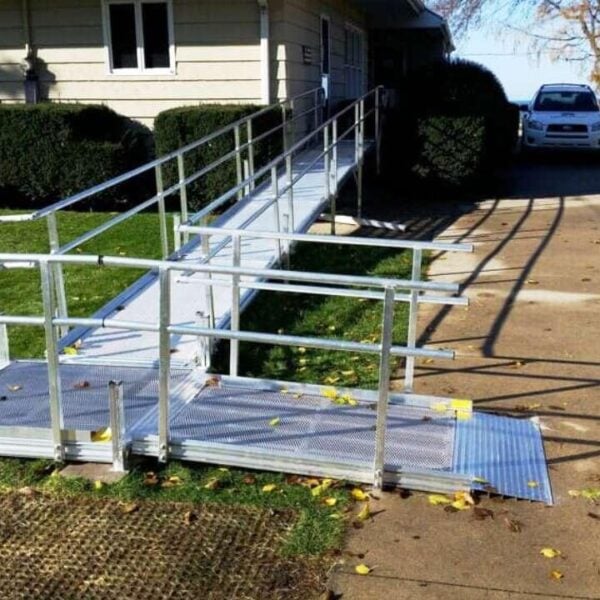
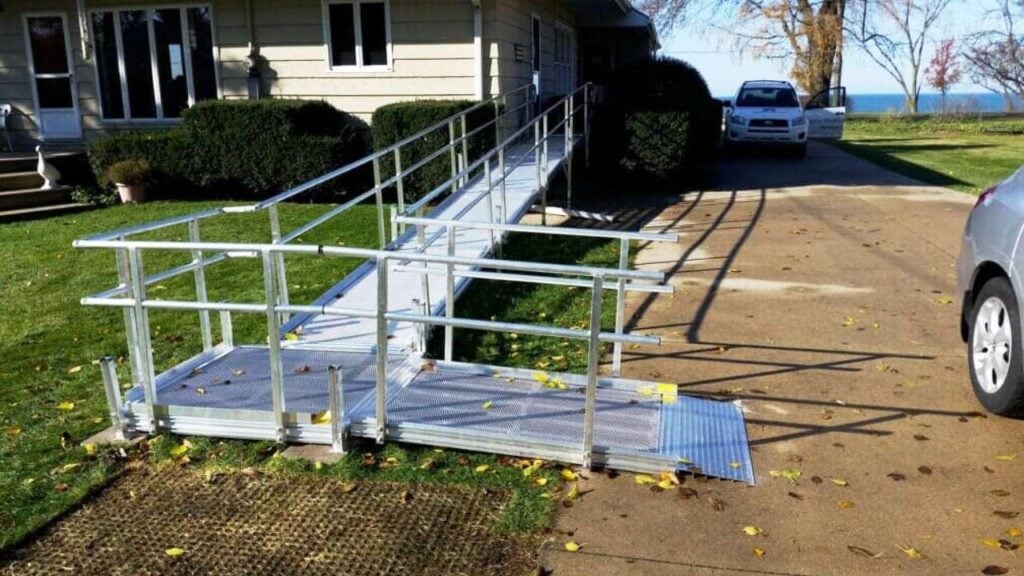
A ground-level side door may need a shorter setup and a simpler layout. A front porch with several steps may need a much longer ramp to create a manageable slope. The higher the entry point, the more ramp sections may be required.
This is also why a home with only three steps can still need a fairly large ramp system. The issue is not just the number of steps. It is the total rise from the driveway, sidewalk, or yard to the finished floor at the entrance. Once that rise is measured, the ramp length begins to take shape.
Longer ramps usually need more landings
Length not only adds straight sections. It often adds landings, too.
Landings are level platforms placed at the top and bottom of ramps, and often at turning points or between ramp runs. They help make the ramp safer and more practical to use. If a long ramp needs to change direction to fit the available yard space, that usually means another landing is needed.
Each landing adds materials, labor, and layout planning. Even when the ramp itself is modular, landings still affect the total installed price. This is one reason why two ramps with a similar total rise may still differ in cost. A straight ramp is often simpler than a switchback or L-shaped design that must fit into a tighter lot.
How the property layout in Detroit can affect the total cost
Ramp length and property layout go hand in hand.
In Detroit, many homes have front porches, side entries, detached garage approaches, or narrower yard conditions. A straight ramp may fit well on one property but not on another. If the available space is limited, the ramp may need to turn once or more. That can increase the amount of platform space and installation work involved.
Trees, fences, sidewalks, existing handrails, and grade changes can all influence the design. Even when the vertical rise remains the same, the cost can increase if the ramp must be routed carefully around existing features.
Material choice matters, but length still drives the total
Homeowners often ask whether wood or aluminum matters more for pricing. Material choice does matter, but ramp length still has a major effect because it controls the amount of that material needed.
For example, a short ramp in one material may cost less than a long ramp in another, but as the design lengthens, the total project cost rises because there is simply more ramp to supply and install.
Longer ramps may require:
- more surface area
- more support structure
- more rails
- more connectors or transitions
- more anchoring
- more site prep
- more installation time
That is why length is one of the most important cost drivers, whether the homeowner is looking for a temporary setup, a rental solution, or a more permanent installation.
Straight ramps vs. switchback ramps
A straight ramp is often the simplest option. It usually works best when there is plenty of room extending outward from the doorway, and the rise is manageable.
But when the ramp must fit into a smaller footprint, a switchback layout may be needed. A switchback ramp uses turns and landings to fold the ramp path into a tighter area. This can be very useful, but it often adds cost by increasing design complexity and introducing additional components.
So even if the needed slope ratio stays the same, the layout can make the final price higher. That is why length alone is not the whole story. The way that length is arranged also matters.
Why is steeper not always cheaper
Some homeowners wonder whether making the ramp steeper could lower the cost by shortening the project.
In practice, safer accessibility standards exist for a reason. A ramp that is too steep can be harder to use and less safe for wheelchair users, walkers, caregivers, and anyone helping with mobility equipment.
Trying to reduce the price by cutting ramp length too aggressively can lead to a setup that is harder to navigate in daily life. It may also create a poor fit for long-term use. For many families, a properly planned ramp is about more than getting into the home today. It is about making daily access smoother and safer going forward.
Longer ramps can add handrails and edge protection costs
As ramp length increases, safety features often scale with it.
Longer runs may require longer handrails, more posts, and more edge protection. These parts are important because they help support stability and reduce risk during use. When the ramp includes turns, multiple platforms, or changes in direction, those features can extend across a larger area.
This means the price increase is not limited to the ramp deck itself. Related safety elements may grow with the length as well.
Site preparation can become a bigger factor on longer ramps
Another reason ramp length affects cost is site preparation.
A short ramp near a smooth, level entry may need minimal prep. A longer ramp may cross uneven ground, soft areas, landscaping edges, or sloped sections of the yard. That can mean more leveling work, support adjustments, or route planning before the ramp is installed.
In some cases, the ramp may need to connect cleanly with a driveway, walkway, or patio. That transition matters because the full path into and out of the home should feel stable and usable, not awkward or abrupt.
Longer ramps simply create more opportunities for site conditions to influence the project price.
Temporary needs vs. long-term needs
Length also affects the decision between temporary and long-term ramp solutions.
If the accessibility need is short-term, such as recovery after a medical event, a rental or temporary ramp may make more sense. If the need is ongoing, a permanent setup may be the better fit.
But whether the ramp is temporary or permanent, the needed length still shapes the price. A temporary ramp for a tall entry can still require a sizable layout. A permanent ramp for a low threshold may still be fairly compact. Length remains a major cost factor either way.
Why a “small height difference” can still create a big project
This is where many homeowners are caught off guard.
At first glance, a porch may not seem very high. But once the rise is measured and the safer slope is applied, the design can turn out to be much longer than expected. Add the need for landings, turning space, rail coverage, and a clear approach, and the project can become more involved.
That does not mean the ramp is overpriced. It means the design is being shaped by real access needs rather than guesswork.
For families planning accessibility improvements in Detroit, that is an important shift in mindset. The question is not only “How much does a ramp cost?” The better question is “How much ramp length is needed to create safer access at this home?”
How to budget more accurately for a ramp in Detroit
If you want a more realistic idea of wheelchair ramp installation cost in Detroit, start with these factors:
Measure the total rise from the ground or walkway to the entry point.
Think about whether the ramp can run straight or will need turns.
Look at the available space in the yard or driveway.
Consider whether the need is temporary or long-term.
Think about who will use the ramp and how often.
These details help move the conversation from a rough guess to a more useful project range.
Why professional planning matters
A ramp is not just a board over steps. It is an access route that should be safe for daily use.
Professional planning helps account for rise, slope, turning space, approach conditions, and how the user will actually move in and out of the home. It can also help avoid the common mistake of focusing only on the doorway while ignoring the full route from the parking area, sidewalk, or yard to the home entrance.
Ramp length directly impacts the total project cost by affecting materials, labor, layout, landings, rails, and site preparation. That is why it is one of the biggest factors behind wheelchair ramp installation cost in Detroit.
A shorter ramp may be simpler and less expensive. A longer ramp may require more planning and a larger footprint, especially when the entry height is greater or the yard layout forces turns. In either case, the goal is the same: create access that feels safe, usable, and right for the home.
For homeowners in Detroit, understanding the relationship between vertical rise and ramp length can make budgeting much clearer. It also helps explain why an estimate is not just based on “a ramp,” but on the amount of access work needed to make the entrance function well every day.
FAQs
1. Why does ramp length affect wheelchair ramp installation cost in Detroit so much?
Ramp length affects the amount of material, labor, railing, platform space, and site work required. A longer ramp usually means a larger project overall.
2. How is ramp length usually determined?
Ramp length is commonly measured from the ground to the entry. A widely used accessibility guideline is a 1:12 slope ratio, meaning one inch of rise for every 12 inches of ramp run.
3. Can a shorter ramp lower the cost?
Sometimes, but only if the entry height and site layout allow it. Making a ramp too short can create a steeper slope that may be harder to use and less safe.
4. Do longer ramps always need landings?
Longer ramps often need level landings, especially when the ramp changes direction or when the rise requires separate ramp runs. These features can increase the project’s total cost.
5. Does CAPS Remodeling offer ramp options in Detroit?
Yes. CAPS Remodeling offers wheelchair ramp solutions for homeowners who need safer access, tailored to their home layout and mobility needs.

Introducing Kevin Olrich, Owner of CAPS Remodeling. As a trusted expert in the field of barrier free remodeling Kevin brings a compassionate approach to create safer, more comfortable, and independent living conditions for the elderly and disabled throughout the State of Michigan. His leadership and experience is at the core of how CAPS provides the best solutions to meet the unique needs of our customers and medical professionals.